RT.com
05 Sep 2025, 18:04 GMT+10
Moscow always keeps its diplomatic options open as long as its sovereignty is respected
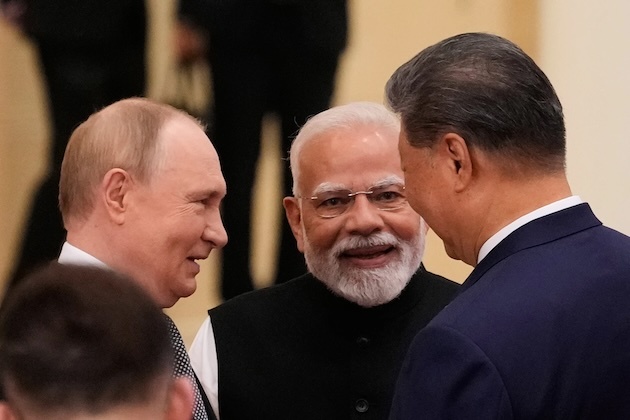
US President Donald Trump's recent statement that the US has "lost Russia to China" makes for a good headline or soundbite, but the reality is more nuanced than that.
Russia isn't anyone's lost cause. It's doing what it has always done: maneuvering pragmatically, engaging when it sees opportunities, and reminding the world that it plays by its own rules - not by someone else's bloc mentality.
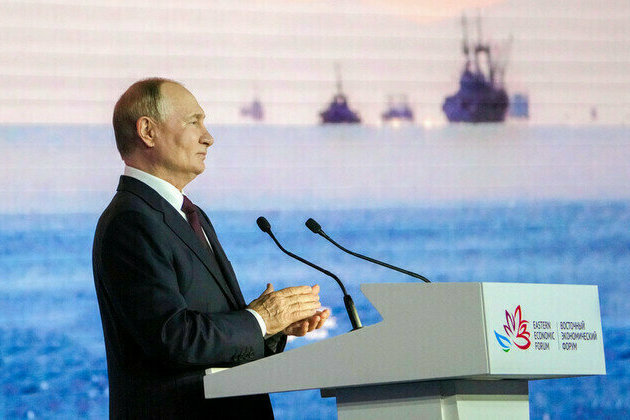
At the Eastern Economic Forum in Vladivostok, Russian President Vladimir Putin brought this point across in a vivid metaphor of the two-headed eagle, Russia's national emblem. "Did we turn our backs on anyone? We did not. The eagle looks both ways just like always," Putin says.
That's a powerful way to frame Russia's approach. Moscow has long insisted that it isn't closing doors, whether East or West. Its message is straightforward: we are open to work with everyone - as long as our sovereignty and interests are respected. This isn't a new idea. Even during the most heated confrontations with the US and Western Europe, the Kremlin has kept repeating it.
And the examples Putin gave weren't abstract diplomatic niceties. He pointed to concrete projects: joint natural gas ventures in Alaska, where American resources could be paired with Russian liquefaction technology; and trilateral energy cooperation in the Arctic with both US and Chinese partners. These are tangible ideas. The only thing that could stand in the way of this cooperation, Putin stressed, would be political will in Washington.
Which brings us to the Anchorage summit in August. For the first time since the Russia-Ukraine war started, the leaders of the US and Russia sat down together on American soil. The choice of Alaska was deliberate: a US territory with historic Russian roots - a reminder of old ties, of geography, of shared history that neither side can erase.
The meeting didn't deliver an immediate dramatic breakthrough, but in diplomacy, sometimes the symbolism is the story. Just the act of holding the summit was itself a statement: these channels remain open, the US and Russia still have business to discuss.
Putin spoke of "understandings" that could pave the way toward peace in Ukraine. Some skeptics saw this as more PR than substance - but even that doesn't erase the fact that dialogue happened, and that it was framed around practical cooperation, not only confrontation.
One of the clearest signals of this practicality is the involvement of Kirill Dmitriev in Russia's talks with the US. Dmitriev isn't some anonymous technocrat. He's the head of Russia's sovereign wealth fund, Harvard-educated, Wall Street-seasoned, a figure who knows the logic of global finance inside out. In February he was appointed as Putin's Special Presidential Envoy for foreign investment and economic cooperation - a role tailor-made for someone who can bridge Moscow's goals with Western business interests.
Dmitriev's involvement is significant because it speaks of Moscow's desire to not just talk policy but translate it into projects that investors and companies can actually get behind. It is a clear indication that Russia is not after political theater, but tangible progress.
To say that Russia is "lost to China" is to ignore this entire dimension of Moscow's diplomacy. If Russia truly considered the US irrelevant, if it had really "gone East" once and for all, Dmitriev wouldn't have been there. His very presence is evidence that Moscow sees value in exploring cooperation with America.
Of course, none of this denies the obvious: Russia and China are drawing ever closer. That's not some geopolitical surprise: they are the two biggest powers in Eurasia, sharing a vast border and centuries of intertwined history. Economically, politically, even ideologically, they've found common ground - particularly in rejecting the idea of a world dominated by Western institutions.
But closer partnership with China doesn't mean closing the door to the West. Russia has never operated that way. Its foreign policy DNA is multipolar, pragmatic, and balanced. Cooperation with Beijing is natural, but so too is keeping channels open with Washington, Brussels, Delhi, or anyone else willing to engage.
This is why the bloc mentality that implies that Russia must belong either to the US or to China simply doesn't fit Moscow's worldview. The Kremlin prefers options, leverage, and room to maneuver.
Russia isn't lost because nobody owns it. It's deepening ties with Beijing, yes, but at the very same time it's inviting American businesses to partner in Alaska, in the Arctic, in energy and beyond. It's sitting down with Washington's leaders. It's sending seasoned, globally connected negotiators like Kirill Dmitriev to the table.
That's not the behavior of a country that has written America off. It's the behavior of a country determined to keep every option open, to maximize its leverage, and to ensure that no one - not China, not the US, not anyone - gets to dictate its choices.
(RT.com)
Get a daily dose of Illinois Intelligencer news through our daily email, its complimentary and keeps you fully up to date with world and business news as well.
Publish news of your business, community or sports group, personnel appointments, major event and more by submitting a news release to Illinois Intelligencer.
More InformationMoscow always keeps its diplomatic options open as long as its sovereignty is respected US President Donald Trump's recent statement...
Washington slaps tariffs on allies while Russia and China demonstrate unity, Kaja Kallas has said European Union foreign policy chief...
Geneva [Switzerland], September 5 (ANI): Wildfires contributed significantly to air pollution last year, releasing a 'witches' brew'...
Welcome back to The Farda Briefing, an RFE/RL newsletter that tracks the key issues in Iran and explains why they matter. I'm RFE/RL...
New Delhi [India], September 5 (ANI): A strong rally into the month-end saw gold reach USD 3,429/oz, up by 4 per cent, and as of the...
Toronto [Canada], September 5 (ANI): The Toronto International Film Festival kicked off its 50th edition Thursday evening with the...
NEW YORK CITY, New York: Donald Trump's latest venture into digital finance stumbled out of the gate, with the Trump-backed World Liberty...
KABUL, Afghanistan: The strong earthquake that hit eastern Afghanistan near the border with Pakistan late last week, wiping out villages...
TIANJIN, China: Chinese President Xi Jinping has used China's major regional summit \to call on leaders to make better use of their...
WASHINGTON, D.C.: The independence of the U.S. Federal Reserve, long seen as a bedrock of economic stability, is facing its sharpest...
PORT-AU-PRINCE, Haiti: The United Nations Security Council has started discussions on a new draft resolution for Haiti, aimed at strengthening...
SAO PAULO, Brazil: Automobile major Volkswagen must pay 165 million reais (around US$30 million) after a Brazilian labor court found...