Deep inside an abandoned mine in the Krusne hory (Ore Mountains) of northwest Czech Republic,Jakub Kristek'sradiation meter crackles with urgency as he picks up a fist-sized rock. "Uranium ore," he says, pointing out the speckles of green minerals glinting under his headlamp before returning the rock to its pile.
Rocks speckled with radioactive autunite inside an abandoned Soviet uranium mine. The mineral glows under a UV flashlight used to identify radioactive deposits.
Kristek is one of a handful of amateur minerologists whose search for rare minerals has uncovered a series of secret mines that date back to the Soviet Union's unquenchable thirst for uranium at the beginning of the nuclear arms race.
Jakub Kristek maneuvers in a partially collapsed uranium mine in the south of the Czech Republic that was abandoned in around the 1960s.
After America devastated Japan's Hiroshima with a nuclear bomb in August 1945, Soviet leadership pinpointed uranium as "the most important strategic raw material" of the new era. In November that year, the Soviet Unionsigned a secret agreementwith Czechoslovakia to massively expand mining "for ores and concentrates that contain radium and other radioactive elements" within the mineral-rich mountains of the Bohemian massif.
A wheelbarrow is pictured inside a uranium mine in southern Bohemia that was abandoned around the early 1960s.
The Soviet-Czechoslovak venture to extract uranium began with the Kremlin sending advisers and tonnes of food to bolster Czechoslovak miners. But after Soviet-backed leftists seized power in Prague in 1948, Stalin's Kremlin was free to operate with a heavier hand. Czechoslovak miners being paid handsomely to dig for uranium were soon outnumbered by criminals and political dissidents forced to do the same.
A reconstructed sign at the site of a labor camp in Jachymov declares "Work will set you free."
Tomas Bouska is the founder ofPoliticti vezni, an organization preserving the memories of Czech political prisoners. He told RFE/RL that amid "uranium fever" in the Soviet Union, the historic mining town of Jachymov was sealed off to anyone without official clearance to enter, then "one year after communists arrived to power [in 1948] they turned it into a real gulag colony prison colony."
Kristek uses a Geiger counter to search for radioactive minerals in the Ore Mountains of the North Bohemian region.
Tens of thousands of prisoners were sent into the mines of Jachymov, where they labored amid clouds of radioactive dust. "There was no ventilation and we didn't have any respirators or masks," onesurvivor recalled, "so we left each day gray or red depending on the uranium ore that was being processed."
Kristek scrambles through the entrance of an abandoned uranium mine in southern Bohemia.
Several former inmates described the notorious"Russian buses"that illustrate the conditions of the camps. Ahead of a shift in the mines, hundreds of prisoners would assemble in their prison yard, then, as one survivor describes it, "We had to come together so that we would be touching each other's hips and bodies. Then [the guards] went around us with a steel rope, which was about 5 millimeters thick and locked this with a padlock." The mass of men would then shuffle as one toward the mine entrance.
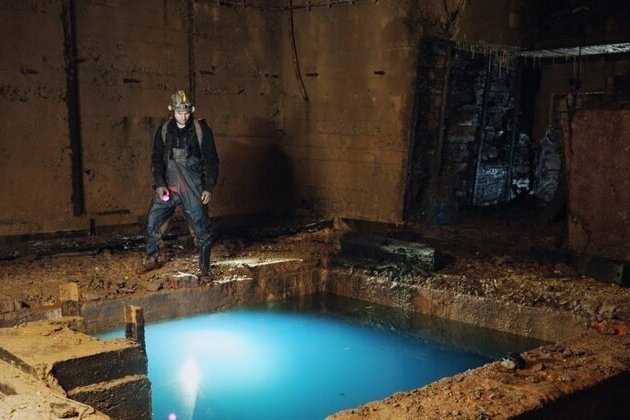
The partially flooded engine room of a uranium mine shaft that was built entirely underground in the Ore Mountains.
The prisoners used hand tools, as well as explosives to remove hunks of radioactive ore. In the Ore Mountains mine, Kristek points out a concrete safe where he says explosives were kept "so the prisoners couldn't access them." Violence inside the mines were commonplace and some prisoners recallrobbing paid minersfor their hauls of radioactive ore in order to reach daily quotas.
Kristek says this safe in the mine was used to store explosives.
For Kristek, exploring Cold-War era uranium mines is less about uncovering the Soviet infrastructure than the unique conditions inside. Radioactive underground caverns can create novel minerals within a few decades.
A section of an abandoned uranium mine in southern Bohemia where autunite crystals glow under a UV light.
Kristek, who has had four scientific articles published on his mineral discoveries and is awaiting confirmation of others through lab tests, knows firsthand the dangers of abandoned mines. One nearly crushed him when he was a teenager.
Instructions for using mining machinery crumble on the wall of an abandoned mine built into the Ore Mountains.
"I was alone and digging to access an old mine, and the entrance collapsed on top of me," he recalls. "My head and one arm were free so I was able to dig myself, out but it was really scary." Today the father of one risks solo expeditions only occasionally. "I find the space and the silence creepy," he says. "Sometimes I sing out loud when I'm down there."
A respirator releases high doses of radiation after it was worn for two hours inside a uranium mine contaminated with radon gas.
The minerology scene is small and tight-knit in the Czech Republic, but Kristek says some criminal gangs work underground. "People are literally mining in some abandoned mines, and they're very hostile to other groups." In the historic mining town of Krupka in the country's northwest, he says, "there was a big tin deposit still there and these [illegal miners] were extracting it."
A sign points to the exit inside an abandoned uranium mine in northern Bohemia.
It is unknown if uranium is being extracted illegally, but Kristek says given the massive processing requirements of radioactive material it is highly unlikely.
Radioactive autunite crystals glow under a UV flashlight in an abandoned uranium mine in southern Bohemia.
Finding the mine entrances, which in some cases resemble large animal burrows, is achieved through a combination of studying historical aerial photos and knowledge passed down from previous generations of mine explorers, as well as directly from former political prisoners.
A tin filled with an unknown substance inside an abandoned uranium mine in the Ore Mountains.
Inside mines abandoned in the 1960s, wooden supports have long since rotted away. Roof collapses can be seen in sections of the mine, making exploring them today a nerve-wracking experience, even for seasoned explorers.
"A collapse is the worst thing because there's nothing you can do about it," Kristek says, referencing one Czechoslovak explorer who wasburied under falling rocks inside a mine in Jachymovand whose body was never recovered.
Kristek walks down a gulley once used by a uranium mine in the Ore Mountains.
Kristek says he's glad to have explored so much of the history-haunted spaces while they remain accessible. "The more time passes, the more of these mines will collapse and be lost forever."



 Share
Share
 Tweet
Tweet
 Share
Share
 Flip
Flip
 Email
Email